Portfolio
Projects
Agent systems, evaluation work, and full-stack builds, most relevant first: agentic RAG, MCP servers, verification for AI-written code, and the occasional hardware hack. Each window below is a live demo or an animated walkthrough.
Enterprise Agentic RAG
An AI assistant that answers questions from a company's own documents, and checks every claim against its sources before replying, fixing or removing anything it can't back up.
Agentic RAG reference architecture on Amazon Bedrock. A LangGraph ReAct loop of three nodes: an agent node where Claude decides whether to search again, answer, or clarify; a tool executor running hybrid retrieval (pgvector dense + BM25, fused with RRF, optional cross-encoder rerank); and a verifier that audits every claim against its cited chunks, sending unsupported claims back for self-correction and stripping ungroundable ones. Hybrid retrieval lifted Recall@10 from 0.68 to 0.89, and eval-driven debugging raised faithfulness from 0.30 to 0.96 by surfacing three real defects. A FastAPI gateway adds JWT tenant and role claims, row-level document ACLs, and rate limiting, observed through OpenTelemetry, Langfuse, Prometheus, and Grafana.
Deep Research Agent & the Grounding Gate
Give it a topic and it researches the web and writes a cited report. Building it exposed a blind spot in AI-written code, so I added a check that catches it.
Interactive CLI research agent on the Strands Agents SDK and Amazon Bedrock. Claude plans and orchestrates Tavily search, extract, and crawl at runtime and writes a Markdown report citing the sources it actually used, with streaming output, partial-save on interruption, and session management. Built end to end through AWS AI-DLC in Kiro from 13 user stories. The generated source extractor passed its own generated tests yet returned 0 of 5 sources against a real recorded Bedrock response, because one model wrote both the code and the tests. I added a Grounding stage to the lifecycle, before test generation, that checks every external contract against type stubs and recorded responses instead of the model. It flagged three divergent boundaries and held the lifecycle until the rewrite returned 5 of 5, now covered by 11 Hypothesis property-based tests.
Agentic Analytics Lakehouse
Ask a business question in plain English and get an answer drawn from both the company's databases and its documents, with no SQL.
Agentic analytics platform on AWS. A Strands agent (Claude Sonnet 4.5 on Bedrock) connects over MCP to a Bedrock AgentCore Gateway secured with Cognito OAuth, routes each question to the right source, and correlates across them, for example surfacing customers flagged for both payment fraud and serial returns. I authored and deployed two FastMCP servers to AgentCore Runtime: one runs Athena queries, one does semantic search over documents in S3 Vectors. Two AWS Glue ETL jobs feed the lakehouse: Aurora MySQL into Apache Iceberg with full change data capture, and Kinesis Firehose into partitioned Parquet with job bookmarking.
osmosis
Reads a codebase's past code-review conversations and writes down the team's unwritten rules, each one backed by the review comments it came from.
TypeScript CLI that mines a repository's pull-request review history through the GitHub GraphQL API and emits an evidence-backed rules file in the shape AI code reviewers and coding agents read. Rules are scoped from repo-wide down to single packages, and every rule cites the review comments behind it. Runs on local models through Ollama at zero API cost. Built in Kiro under AWS AI-DLC: 11 units of work, 265 tests. The first live run against prisma/prisma turned 400 PRs and 1,276 human review comments into 20 rules, about 8 of them substantive. It also exposed two bugs synthetic fixtures had hidden: a GraphQL field that does not exist passed 17 integration tests written against a hand-made fixture, and bot detection missed review bots whose logins lack a [bot] suffix. Next: an evaluation of whether mined rules predict held-out review comments better than generic ones.
acuity
Learns which kinds of automated code-review comments each team actually acts on, and which they ignore, from signals GitHub already records.
TypeScript CLI and evaluation harness built on one observation: a review thread's outcome is already on GitHub. Crossing whether the flagged code changed (isOutdated) with whether a human resolved the thread (isResolved) labels each AI-reviewer comment as acted on, acknowledged, or ignored, with no extra input from anyone. Across 6,687 AI-reviewer comments on five open-source repos, that implicit outcome existed for every comment, while only 4 to 36 percent carried an explicit reply, up to 26x more labeled events. Teams really do disagree: act-on rates for performance, error-handling, and security comments spread 28 to 36 points across repos. Pooling preferences across teams helped only at small-sample cold start, reported as a negative result rather than tuned away. 106 tests, $0 in API spend on local models.
SAP Flight Booking Backend, Generated over MCP
The behind-the-scenes engine for an airline booking system (search, book, pay, cancel, refund, e-ticket) on SAP, the enterprise software big companies run on, written by an AI coding agent that I directed and kept to standard.
Drove a coding agent over the ABAP Model Context Protocol server through the full AWS AI-DLC lifecycle in Kiro to generate a greenfield booking backend on SAP ABAP OO and HANA: 14 ABAP classes and 5 CDS views over SAP's standard flight tables, a facade over the flight, booking, customer, payment, ticket, validation, and cancellation domains, and 4 REST handlers, dependency-ordered across 6 activation phases from 19 user stories. I wrote the 258-line steering ruleset (naming conventions, CDS view-type selection, mandatory syntax checks after activation) that held the generated code to enterprise standards, and an agent hook that restarts and reconnects the MCP server mid-session. Object creation in the live workshop system was blocked by MCP permissions, so the objects were generated and ordered but never activated.
Quote-to-Cash ARR Agent on Salesforce
Explains why a customer's recurring revenue went up or down between two periods, in plain English, with every number computed by code and never made up by the AI.
Salesforce build that attributes an account's ARR change between two periods to new business, expansion, downgrade, or churn, splits each movement into volume and price effects, and reports any unattributed residual with a reconciliation check. It also surfaces non-standard discounts and co-termed amendments that standard reporting does not expose. Deterministic Apex computes every figure and the model only narrates them, so it structurally cannot fabricate a number. A 388-line Apex engine with 11 passing tests reproduces a hand-computed revenue waterfall exactly, with zero residual, behind a Flow built to be called as an Agentforce agent action. Registering that action in Agent Builder is the remaining step.
IoT Sensor Monitoring Platform
Collects a stream of sensor readings, flags unusual values as they arrive, and keeps the dashboard fast even under heavy load.
Distributed, event-driven system built solo for CS 426 (Distributed Systems): 8 containers running HTTP ingestion, a sensor registry, and read APIs alongside queue-draining storage and pub/sub anomaly workers over Redis and per-service PostgreSQL, plus a traffic simulator. Idempotent ingestion, a dead-letter queue for poison messages, cache-first reads, and health-gated startup. Load-tested with k6: with caching on at 50 virtual users, throughput rose from 137 to 928 requests per second while p95 latency on the latest-reading endpoint fell from 13.3 ms to 3.1 ms, with zero failed requests.
AI-Powered SOW Editor
Paste in a meeting transcript and it auto-drafts the project contract, while an AI assistant suggests the rest — you just accept, reject, or edit, then export to Word or PDF.
Built at Comprinno Technologies, where I was the sole engineer on the platform, reporting to the CTO; it cut client document prep time 40%. React-based Statement of Work editor with real-time Claude assistance via Amazon Bedrock. Rich text editing with Slate.js, inline AI suggestions, document state management with Zustand, change tracking, undo/redo, and PDF/DOCX export.
Real-Time Voicebot
A voice assistant you can talk to naturally — and even interrupt mid-sentence, just like a real phone conversation, with answers in under half a second.
Voice assistant powered by Amazon Nova Sonic via AWS Bedrock's bidirectional streaming API. Features barge-in detection (interrupt mid-response like a real conversation), async tool use for live data lookup, a Streamlit UI, and PyAudio-based I/O with separate 16 kHz input and 24 kHz output streams. A second version on Pipecat adds a browser client with echo cancellation, voice-activity barge-in with Silero VAD, and tool calling.
Mobile Mechanic Platform
A website where customers can check if a mechanic serves their area and book one to come fix their car at home — try the live demo on the right.
CS 320 team project: a full-stack booking platform for an on-demand mobile mechanic service. Next.js and TypeScript frontend with service-area lookup and appointment scheduling, Python backend on Supabase/PostgreSQL, and a Playwright end-to-end suite enforced in GitHub Actions CI, deployed on Vercel.
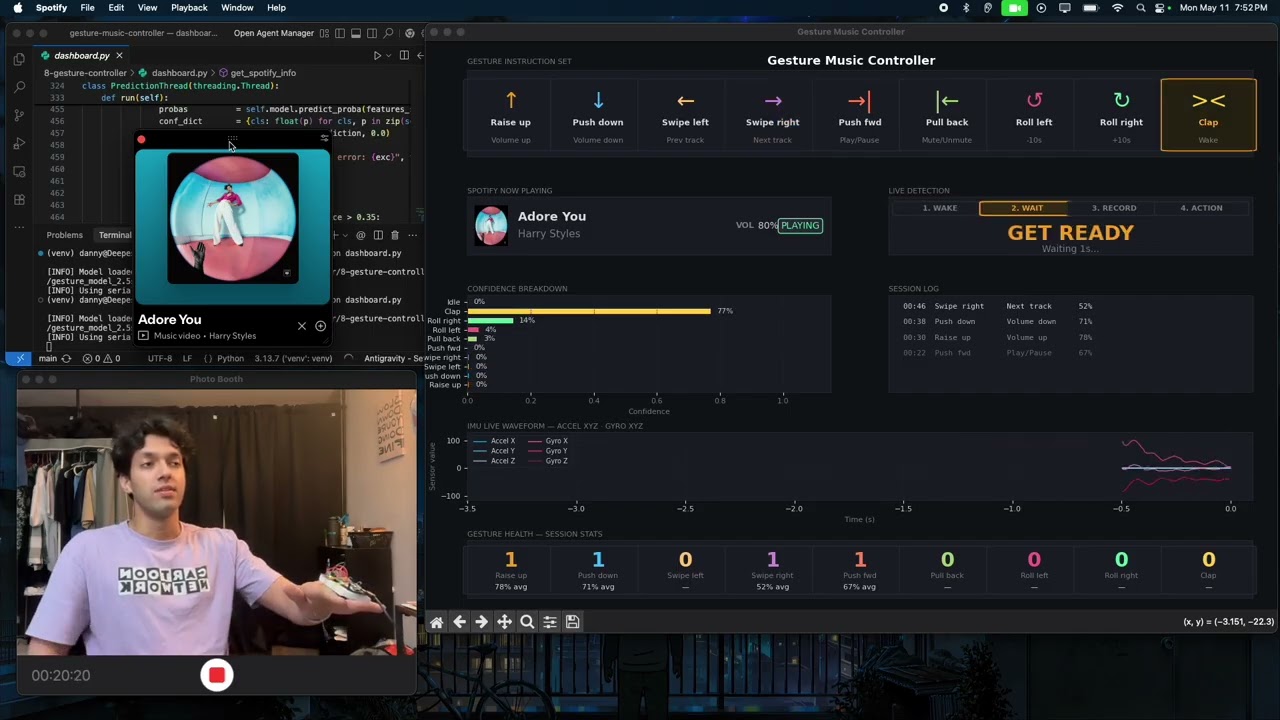
Gesture Music Controller
Wave your hand in the air to control Spotify — skip a song, pause, or change the volume — using a tiny motion sensor and machine learning. Watch the video demo on the right.
Real-time mid-air gesture recognition for Spotify control. An ESP32 + IMU sensor streams 6-axis data over serial; Butterworth DSP filters clean the signal before a hybrid ML + physical-polarity classifier achieves 99%+ accuracy. A live 6-panel Matplotlib dashboard shows waveforms, confidence, and Spotify metadata in real time.